
SubAgent Construction product features
Find the material the job needs
Whole slabs and retained off-cuts share a register with dimensions, locations and movement history.
Preserve the agreed scope
Quotation revisions, fabrication measurements and accepted variations keep their own identities.
Record each handover
Assignments, work stages, independent QC and installation evidence stay linked to the job.
Connect the work from slab to site
SubAgent Construction connects material, quoting, fabrication, installation and job money. Warehouse staff find and issue stone; coordinators keep scope and measurements together; workers record the work; directors and accountants follow the job through their permitted records.
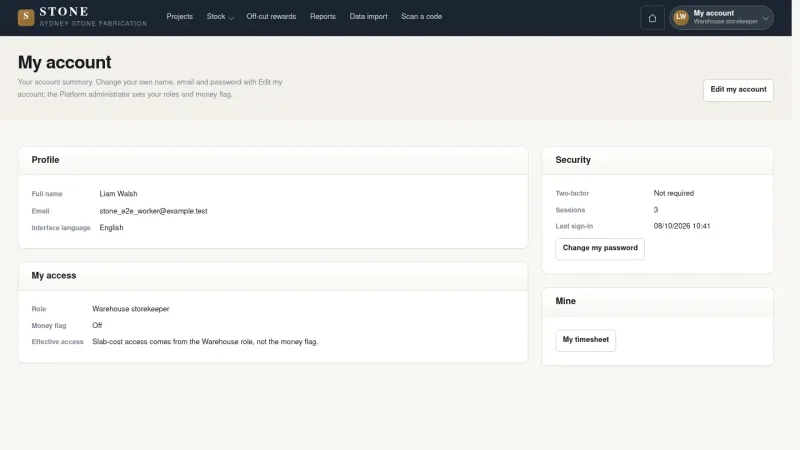
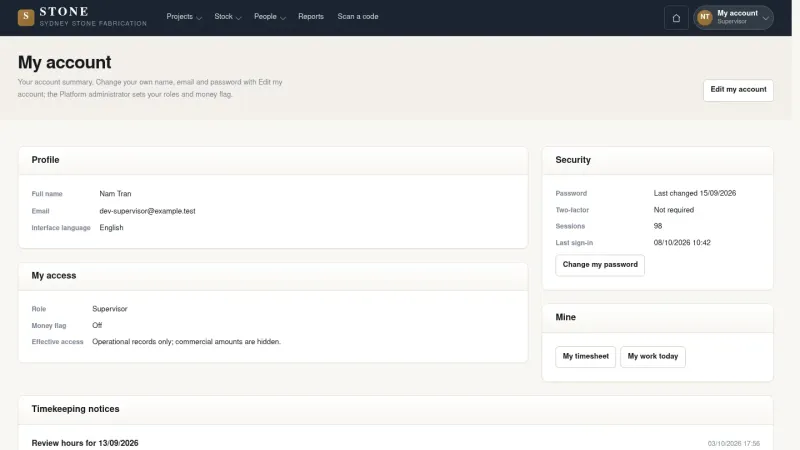
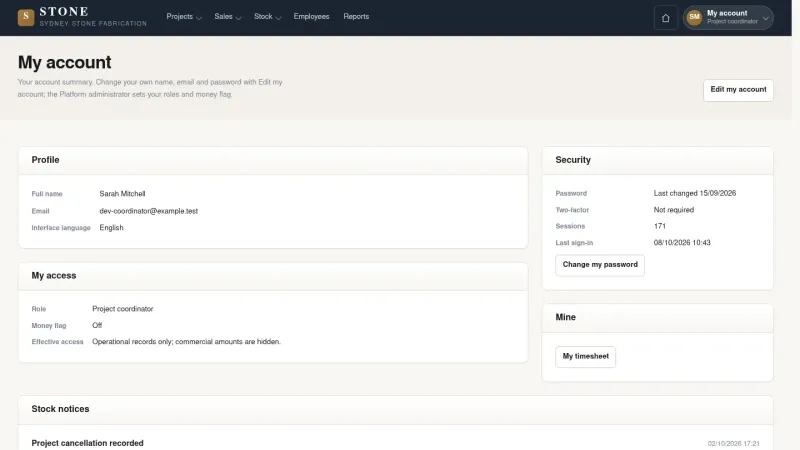
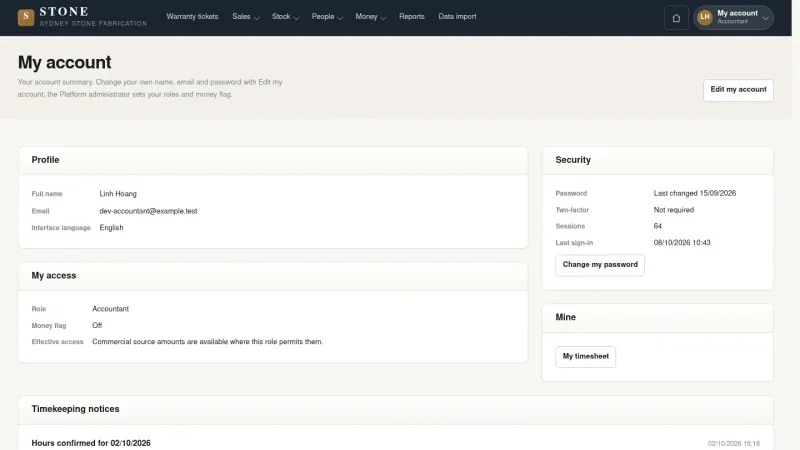
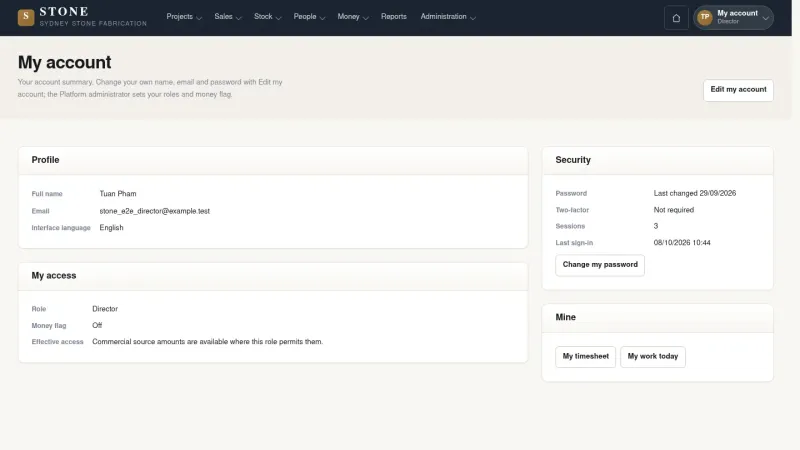
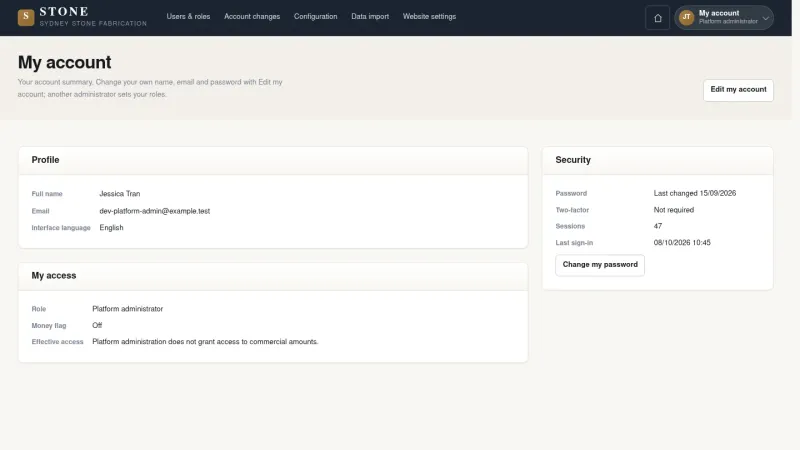
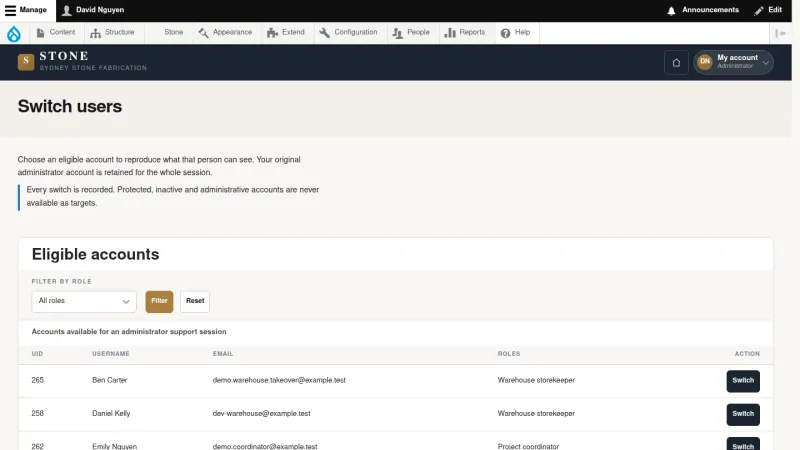
Screens on this page were captured on 8 October 2026 and retain sample records. Later accepted updates open collection, margin, warranty, safety and reports; older held notices in these images describe the capture date.
 View full size
Keep each part of the job connected
Material, approved scope, work records and direct costs stay linked to the job.
- StockSlabs and off-cutsReceive, find, reserve and issue material with traceable movements.
- QuotesScope and revisionsPrepare quotations and keep later changes linked to the original job.
- MeasuresSeparate approvalAn approved fabrication revision defines the components to cut.
- WorkAssignments and QCWorkers record execution; eligible supervisors check the work independently.
- SiteVisits and evidenceCapture measurements, photographs, installation progress and signature outcomes.
- MoneyClaims and collectionSend ex-GST claims, record receipts and retain reversal history.
- ReportsJob and stock factsReview stock, rework, crew, margin, debtors and off-cut reuse under role access.
- WarrantyService follow-upRecord coverage, complaint photographs, completion and a reasoned reopening.
For the teams handing work to one another
Each person opens the tasks and records their role permits. One account can combine business roles.
Warehouse staff managing stone
Explore inventoryFind suitable stock, keep locations accurate and record each reservation, issue or permitted return.
Office staff coordinating jobs
Explore job preparationKeep the customer, quotation, measurement revisions, work orders and installation plan together.
Workshop and installation teams
Explore executionOpen assigned work on the phone, record execution and preserve evidence for the next handover.
Directors and accountants following the job
Explore job moneyReview authorised approvals, direct costs, payment claims, receipts and job margin.
Follow a job through the work
The agreed quotation and the approved fabrication measurement remain separate records throughout the journey.
Open the job
Record the customer, site and job identity; follow up a website enquiry where relevant.
Prepare the quotation
Use quoting measurements and effective rates to establish the proposed scope and price.
Keep the accepted scope
Record Won; keep subsequent scope changes in accepted variations. Claims do not block work.
Approve fabrication
Re-measure for fabrication and submit the correct revision for independent director approval.
Find and issue stone
Choose stock for an approved line, reserve it and issue it to the work order.
Fabricate and check
The worker starts and finishes the assigned stage; eligible staff close it and perform independent QC.
Reconcile the cut
Record consumed material and retained off-cuts; keep lineage and direct material cost connected.
Install and hand over
Record visits, photographs and signature outcomes. Resolve punch items before final handover.
Collect and follow up
Review claims, receipts, direct costs and margin; manage warranty and qualified off-cut reuse.
Keep scope and fabrication authority clear
A quotation agrees price and scope. A separate approved fabrication measurement defines the revision and components the workshop may cut.
- Prepare quoting and fabrication measurements as separate records
- Directors approve, return or approve by exception with a reason and self-approval protection
- Use Create revision for a Sent original; Quote again for Lost or Expired on a new successor job
- Record accepted variations after Won instead of overwriting the agreed scope
- Capture photographs on the sheet and each measured line
 View full size
Follow the work from workshop to site
Assignments connect each component and material piece to its work order. Workers record their execution; independent quality checks decide what moves forward.
- Open assigned work through My work or Scan in the browser
- Keep Start and Finish with the worker performing the task
- Use eligible close-stage, QC and linked rework actions within the effective team
- Return an issued slab to store only while every linked work order is still Queued or Assigned
- Record installation photographs, signature outcomes and unresolved punch items
 View full size
Connect collection to the job’s direct costs
Accountants manage payment claims and receipts; permitted readers review job margin and debtor ageing. Claims stay independent of measurement, production and installation progress.
- Send a Draft payment claim by email with its PDF to a valid customer contact after payment terms are set
- Record append-only receipts and correct a mistake with a reversal
- Review outstanding debtors by working-day age and retention on each job
- Compare the won original and accepted variations with material, labour, other direct and completed subcontract costs
- Use ex-GST figures: a payment claim is not a tax invoice
 View full size


Live demo
Each demo is a working copy of SubAgent Construction with sample data, open for you to try.
From separate records to a connected job
Review how linked material, measurements and work records support the handovers in your operation.
| Separate records | SubAgent Construction | |
|---|---|---|
| Material selection | Codes, sizes and locations checked across separate lists | Search whole slabs and off-cuts against the approved job requirement |
| Scope changes | New copies can obscure the agreed version | Quotation revisions and variations preserve their relationship to the job |
| Fabrication handover | A quotation or message can be mistaken for cutting authority | Work orders refer to an approved fabrication measurement revision |
| Work progress | Updates depend on separate messages | Assigned work, stage execution, QC and rework have linked records |
| Site completion | Photos and sign-off may sit away from the job | Installation visits, evidence and punch items stay linked |
| Collection and costs | Balances and direct costs are assembled from different records | Claims, receipts, reversals and direct-cost sources refer to the job |
Preserve the material and job relationships
Every record has a place in the job and a responsible person; retained stone can become material for a later job.
SubAgent Construction Material identity, approved work and operational records
Material identity Whole slab, retained off-cut, batch, location and movement history
Reserved and issued for the job
Approved job scope Customer, quotation, fabrication measurement, components and accepted variations
Work and cost records refer to their source
Work and follow-up Production, QC, installation, claims, receipts and warranty; an off-cut keeps its parent lineage
Product capabilities
- Inventory register, goods receipts, material search, reserve, issue and guarded return to store
- Customers, effective price rates, quotations, revisions and accepted variations
- Measurement revisions, components, assignments, execution, QC and rework
- Installation visits, evidence, punch items, subcontract packages and warranty
- Claims, receipts, retention, debtor ageing, direct costs and permission-qualified margin
- Role-specific reports, health and safety records, document reminders and qualified off-cut rewards
Your operation at rollout
- Opening stock, codes, locations, labels and material photographs
- Customer contacts, payment terms, price items and current rates
- Crew responsibilities, assignments and effective team membership
- Timesheet rules, reward tiers and approvals appropriate to your staff
- Warranty duration, deposit percent and document reminder settings
- Hosting, devices, migration, training and acceptance criteria agreed for your rollout
Start with the records your team uses
Agree the operational data and responsibilities, then review the journeys with the people who perform them.
From operational data to an agreed rollout
- Prepare the records Confirm stock, locations, customers, price rates and user responsibilities. Stock and identity
- Review one complete job Follow a quotation, approved measurement, work order, installation and collection with the relevant people. Job handovers
- Check real devices Try labels, camera, printing and phone tasks in the warehouse and at the site. Working conditions
- Agree the rollout Set configuration, data migration, training, support and acceptance for your operation. Deployment agreement
Keep the handovers accountable
Record states and permissions keep each handover tied to the material, scope and person responsible.
- Fabrication approval stays separate A won quotation does not itself authorise cutting; the workshop uses the approved measurement revision.
- The stock history remains traceable A return or correction adds a reasoned movement; cancelling a job does not release stock by itself.
- QC stays independent A person who performed the work does not pass their own QC; multiple roles do not remove that restriction.
- Site evidence follows the signature rule At $100,000 ex GST or when contract value is unreadable, a real signature is required. Lower-value substitute evidence belongs to the visit.
- Rewards follow actual reuse A retained off-cut earns no reward by itself. Qualified reuse on another job, a reward table in force, approval and payment remain separate steps.
- Health information keeps its own access The employee, director and accountant read permitted health documents. Expiry reminders stay inside the application; the reminder setting is agreed at rollout.
Work situations the product supports
A warehouse team finds a retained piece with the dimensions a new job needs, checks its lineage and location, then reserves and issues it under the job’s approved requirement.
Material reuseWarehouse workFind, reserve and issue A coordinator preserves the quotation that was agreed, submits the fabrication revision for approval and gives the workshop components with a clear source.
Job preparationOffice to workshopScope, revision and approval An accountant sends a payment claim, records collections and corrections, and reviews the outstanding balance alongside direct costs without holding up the installation team.
Collection follow-upJob moneyClaims, receipts and costs
Questions about SubAgent Construction
What is SubAgent Construction for?
SubAgent Construction connects the operational records of a stone construction and fabrication company: inventory, sales, measurements, production, installation, people, collection and warranty.
Does a won quotation authorise cutting?
The agreed quotation and fabrication authority are separate. The workshop works from the approved fabrication measurement revision and its linked components.
Can an issued slab return to stock?
The warehouse can record Return to store with a reason while every work order naming the slab is still Queued or Assigned. Once production has started, the slab cannot be returned through that action. Cancelling a job does not return it automatically.
Do payment claims block work on the job?
No. Recording Won can raise a Draft deposit according to the company percentage, 50 by default; setting it to 0 creates no Draft. A claim does not block measurements, production, installation, handover or close. Sending requires a valid contact email and customer payment terms.
How are collection and margin handled?
Claims and receipts use ex-GST amounts; claims are not tax invoices. Receipts are append-only and corrected through reversals. Permitted readers can review debtor ageing, retention and job margin; accountant and coordinator margin access also requires the money flag.
Does an off-cut automatically earn a reward?
Keeping the piece creates stock. A reward depends on eligible cross-job reuse, the reward tier table in force, director approval and an accountant recording payment. The existing opening tier table still awaits independent approval.
What happens after installation?
The job retains its visits, evidence and punch items. Warranty is 24 months from handover by default, configurable for the company; coordinators record coverage, completion and a reasoned reopening. Complaints after expiry require an Ineligible or reasoned Exception decision.
Can staff use a phone?
Assigned work, scan, measurements, installation and an off-cut finder run in the browser. The off-cut finder searches length, width and stone without needing a job and never reserves. Open the piece to check it; reserve from Find stone using the approved job and measurement line. Native application and full offline operation are outside the current scope.
What should be agreed for rollout?
Review stock and customer data, roles, crew and time policies, reward tiers, document reminder settings, devices, hosting, migration and acceptance. Accounting export, report export, automated chasing and tax or payroll accounting remain outside the current release.
A guide for every role
Open a role guide for concrete actions, expected results and the relevant screens.