

Some of the systems an organisation needs have been built before: a learning platform for staff training, ordering for a group of restaurants, hotel bookings and housekeeping, court bookings for sports venues, tickets and appointments. When one of our ready-made Drupal platforms already does most of what you need, platform implementation is the shorter route: we start from the version running in production, fit it to your organisation and connect it to the systems you already run. You see it working on real code, with your own case set up on it, before anything is signed.
Who this is for
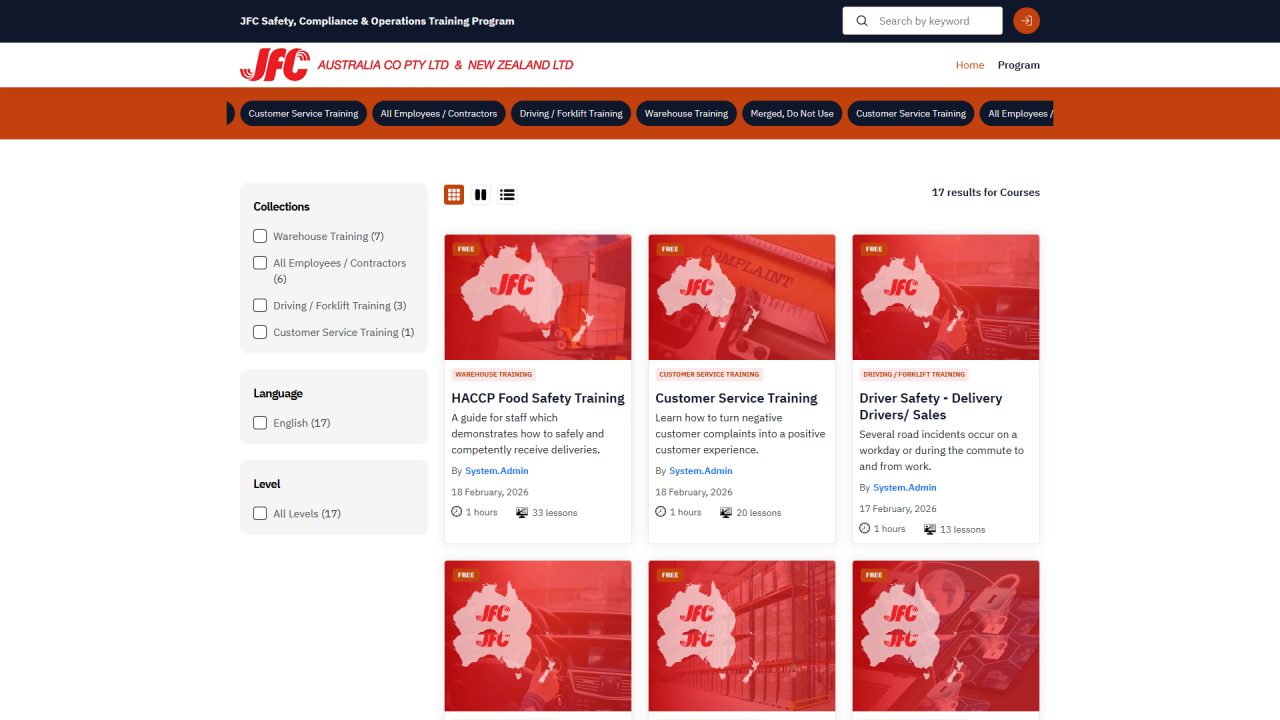
- An employer or a training provider. Courses, quizzes and certificates for staff or learners, with the catalogue sorted by who each course is for: EverLMS.
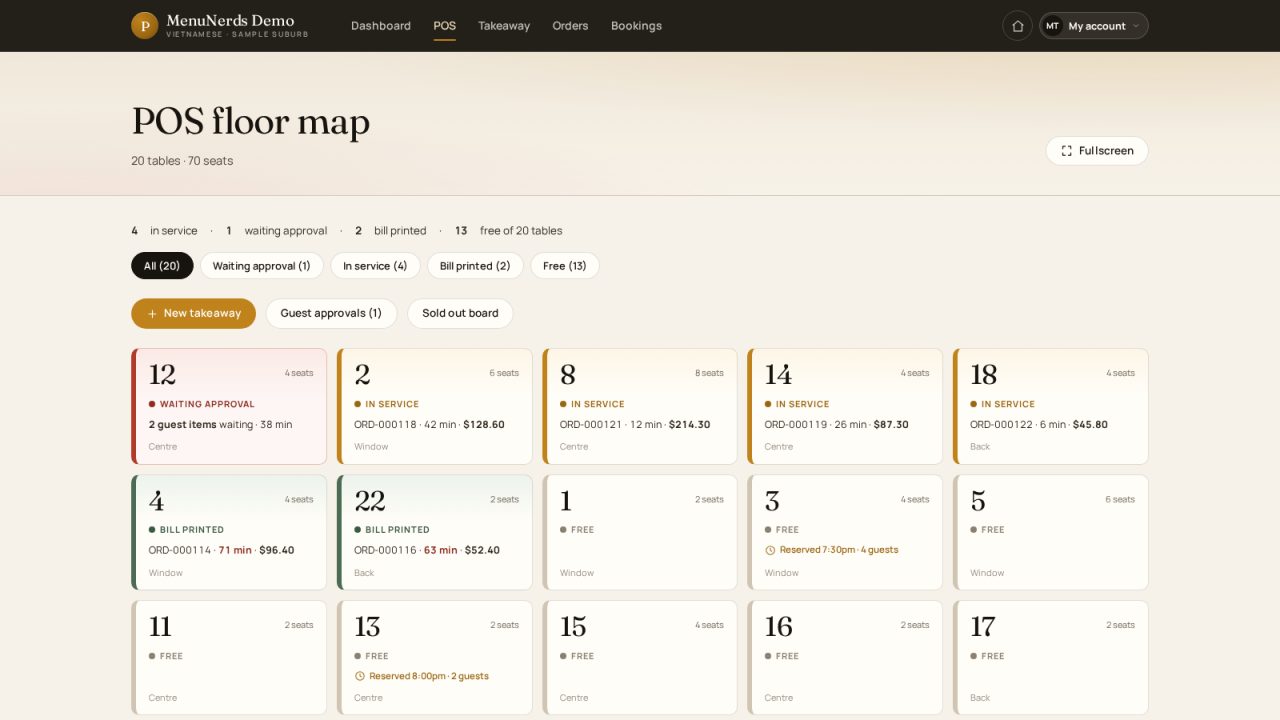
- A restaurant or a group of restaurants. Ordering at the table, the kitchen display, payment at the counter and a franchise view across stores: MenuNerds.
- A hotel, a resort or a lodging operator. Direct bookings on your own domain, the room board, housekeeping and in-room ordering: MineRooms.
- A sports venue or a venue operator. Court bookings against live availability, memberships, pricing by day and demand, and open games: MineCourt.
- A venue, organiser or clinic that sells tickets or takes appointments. Admission and event tickets with seat selection, or appointments with a chosen provider: MineTickets.
- An agency whose client needs one of these systems. We deploy and adapt the platform together with you, under your name, and your client receives the running system. The partner programme sets out how that works.
When none of them is close, starting from a platform saves nothing. A system shaped around your process from the first line is a web application, and a product you intend to sell to others is product development.
What you get
- A fit report that marks each of your requirements as already in the platform, configured for you, or built for you
- The platform deployed on your domain, on your infrastructure or on hosting we operate
- Your roles, workflows, branding and content set up, with your existing records moved in
- Integrations with the payment provider, CRM, ERP or other systems you already run
- Customisation kept in its own modules and configuration, apart from the platform core
- Documentation for a developer who has never met us, and training for the people who run the system day to day
Sample Platform fit report Staff training portal on EverLMS · example.org
| Requirement | Comes from | Note |
|---|---|---|
| Courses in modules, with a quiz at the end | In the platform | Course, chapter and lesson structure; quizzes scored automatically, every attempt recorded. |
| A certificate on completion, with our logo | Configured | A certificate template built from your artwork and signatures. |
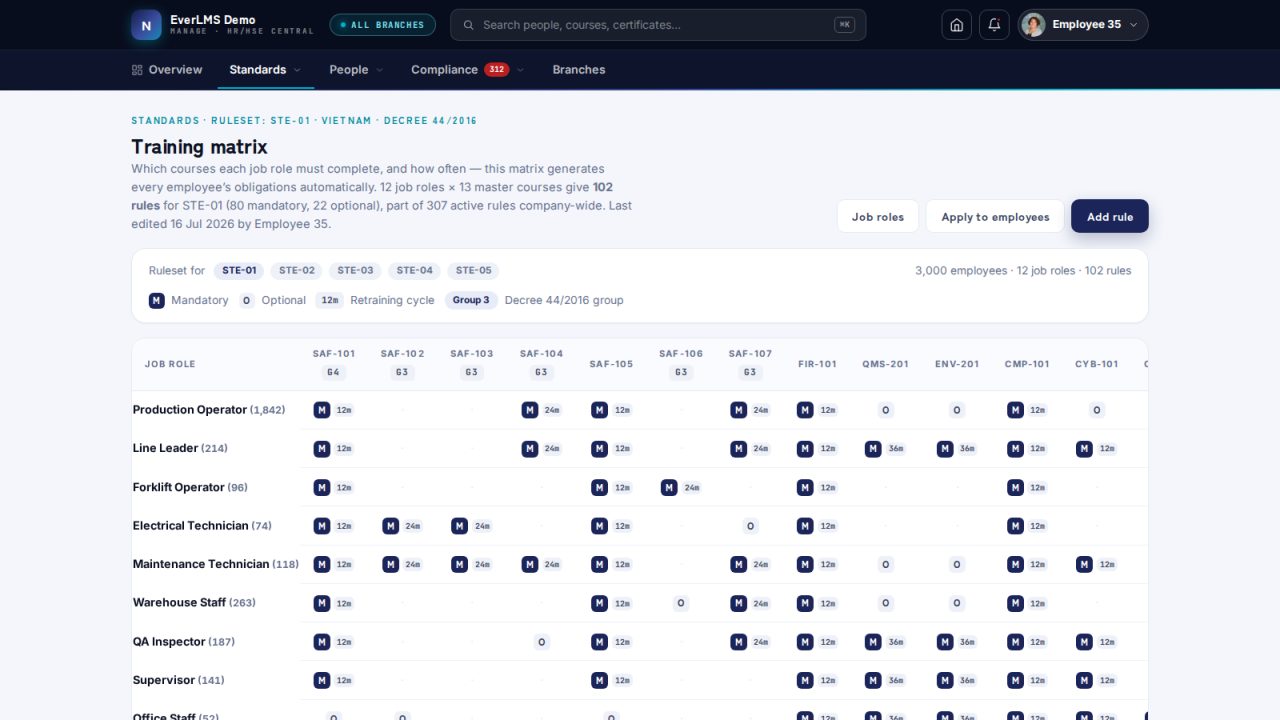
| Courses assigned by job role | Configured | Collections and a training matrix set up for your roles. |
| Staff records kept in step with the HR system | Built for you | An import against the HR system's export, specified before the price is fixed. |
An engineer reads it and replies within one business day.
How a platform implementation runs
The order is the same as for any build we run. What changes is the first thing you see: a system already in production, walked through with you, rather than a design. The process is written up in full in how a project with us runs.
How a platform deployment runs
- Discovery The platform walked through one role at a time, against what your organisation does. Output: the fit report
- Prototype Your own case set up on the platform, at no charge, before any contract. Output: the prototype
- Fixed price Priced once the fit report and the scope built for you are agreed. You keep the scope
- Build Configuration, records and integrations landing on a staging site you can use. You keep the repository
- Acceptance Each role tested against the agreed scope before launch. You keep the test record
- Warranty Defects in what we built are ours to fix, one year by default and up to three. You keep the handover pack
Platforms we implement
Each platform is our own, built on Drupal and running in production. Their pages set out what each one does and where it runs; this is the short version.
- EverLMS, learning. Courses, quizzes, certificates, memberships and a back office per role. In production at JFC System Australia, at lms.jfcsystem.com.au.
- MenuNerds, restaurant ordering. From the guest at the table to the waiter, the kitchen, the counter and the franchise admin. In production for a restaurant franchise in Australia, with a subdomain per store.
- MineRooms, hotel bookings and operations. The booking journey, the room board, housekeeping and in-room ordering. Runs live at mine-rooms.com.
- MineCourt, court bookings. A booking grid, memberships, open games and reports across venues. Badminton venues in Ho Chi Minh City take court bookings on it.
- MineTickets, tickets and appointments. Admission and event tickets with seat selection, and appointments with doctors, dentists, spas and salons. Runs live at mineticket.com.
More platforms are on the way.
What stays in the platform, and what is yours
A deployment has a core and a layer of your own. The platform core is the version already running in production. Your layer is everything shaped around your organisation, and it is kept apart from the core so that the core can move forward without taking your changes with it.
A platform deployment Your layer sits on the core and never inside it
Your systems Payment provider, CRM, ERP and the records you already keep
Integrations built for you
Your layer Roles, workflows, branding, content and the modules written for you
Kept apart from the core
Platform core The version in production, updated as the platform is released
What goes into your layer depends on the platform. On EverLMS it is usually the course catalogue, certificate templates and completion rules, enrolment and payment, and the content you already have, whether SCORM packages, video or live classes. On MenuNerds it is the menu and promotions, the store structure from a single site to a chain with a subdomain per store, and payment at the counter. On MineRooms it is room types, rates and pricing rules, the payment provider and the menu behind in-room ordering. On every platform it includes your branding, your domain and the reports your managers read.
When the core is updated, your layer is not overwritten: the update is applied on staging first and tested against your layer before it reaches the live system.
What it costs
A deployment is placed in the project tiers on the pricing page like any other build, by what the finished system has to do: the roles, the integrations, the records to move and the languages. A training portal for one organisation and an ordering system across a franchise with a store per subdomain sit in different tiers. What already runs in the platform is not charged as if it were written again; the price is for the part built for you, fixed once the fit report is agreed.
The tiers, from Micro to Strategic, are on the pricing page, and the fit report says which one your deployment is in. Hosting and maintenance after launch are priced separately under maintenance and support.
Work we have delivered
The full case studies behind the screenshots on this page.
Terms that hold
These terms hold across our services; where a service starts differently, its page says how. The full wording is on the warranty page and in why you own the source code.
- A prototype before you sign a build Before a build project is signed, we build a prototype at no charge: a design, a clickable prototype or a working demo on real code, so you decide against something real.
- You receive the system and its source code Custom work is yours from the first commit: the repository, custom modules, theme and deployment configuration. When we build your system on one of our platforms, you receive the whole system and its source code as well.
- A warranty on development work Development projects carry a 1-year warranty by default, up to 3 years. It covers defects in what we built, and applying the security releases of Drupal core and contributed modules while the warranty runs. Maintenance picks up where the warranty leaves off.
- Response targets we publish A first response in 4 hours for critical issues, 1 business day for high priority and 3 business days for normal. Support runs in business hours; cover outside them is an option, priced separately.
Questions we get asked
How close does a platform have to be before it is worth starting from?
Close enough that most of your requirements come back from the fit report as in the platform or configured. When most of them come back as built for you, starting from the platform mostly adds code you would have to work around. We say so at that point and quote a web application built for your process instead.
What does the prototype show before we sign?
Your case on the platform, not a general demo: your course structure, your menu and stores, your room types or your venues, set up on the version in production so you can go through it one role at a time. It costs nothing, and you decide against something real.
What happens to our changes when the platform is updated?
They stay. Customisation lives in its own modules and configuration, apart from the platform core, so an update does not overwrite it. Each update is applied on staging first and tested against your layer before it reaches the live system.
What exactly do we receive at handover?
The running system and its source code: the platform as deployed for you, the modules and configuration built on top, the theme and the deployment setup, in a repository your organisation controls. Where it runs is your choice; the FAQ covers hosting it on your own servers.
Can we start with one location and add more later?
Yes. On MenuNerds a new store joins through the franchise admin's multi-store setup, on a subdomain of its own. MineRooms runs a hotel group's branches from one platform, and MineCourt gives the company owner every venue in one view. A new location is added to the system you already run, not built as a separate one.
Can an agency deliver one of these platforms to its own client with you?
Yes. We deploy and adapt the platform together with you, under your name, and you keep the client relationship; your client receives the running system and its source code. The commercial side is agreed per partnership before you commit, and the partner programme explains how it works.
Can we subscribe to a platform instead of having it deployed?
No. We do not run the platforms as a shared service for end clients. Each deployment is a system of its own, on your domain and your infrastructure or on hosting we operate for you, and it belongs to your organisation. If a subscription tool already does what you need, it may well be the cheaper answer, and we will say so.
Not covered here? Ask us directly.
Tell us what you runAn engineer reads it and replies within one business day.
Tell us what the system has to run
Describe your organisation, who will use the system and what it must do on the first day. We will say which platform is closest, or tell you plainly that none of them fits.
An engineer reads it and replies within one business day.