
Case study
JFC
We deployed and customised EverLMS as JFC's staff training portal, where employees and contractors find the courses for their role and take the quizzes, and we maintain it.
An engineer reads it and replies within one business day.
The client
JFC runs its staff training on a portal at lms.jfcsystem.com.au, published under the name JFC Safety, Compliance & Operations Training Program. The portal's footer names the business behind it: JFC Australia Co Pty Ltd together with JFC New Zealand Limited, headquartered in Sydney.
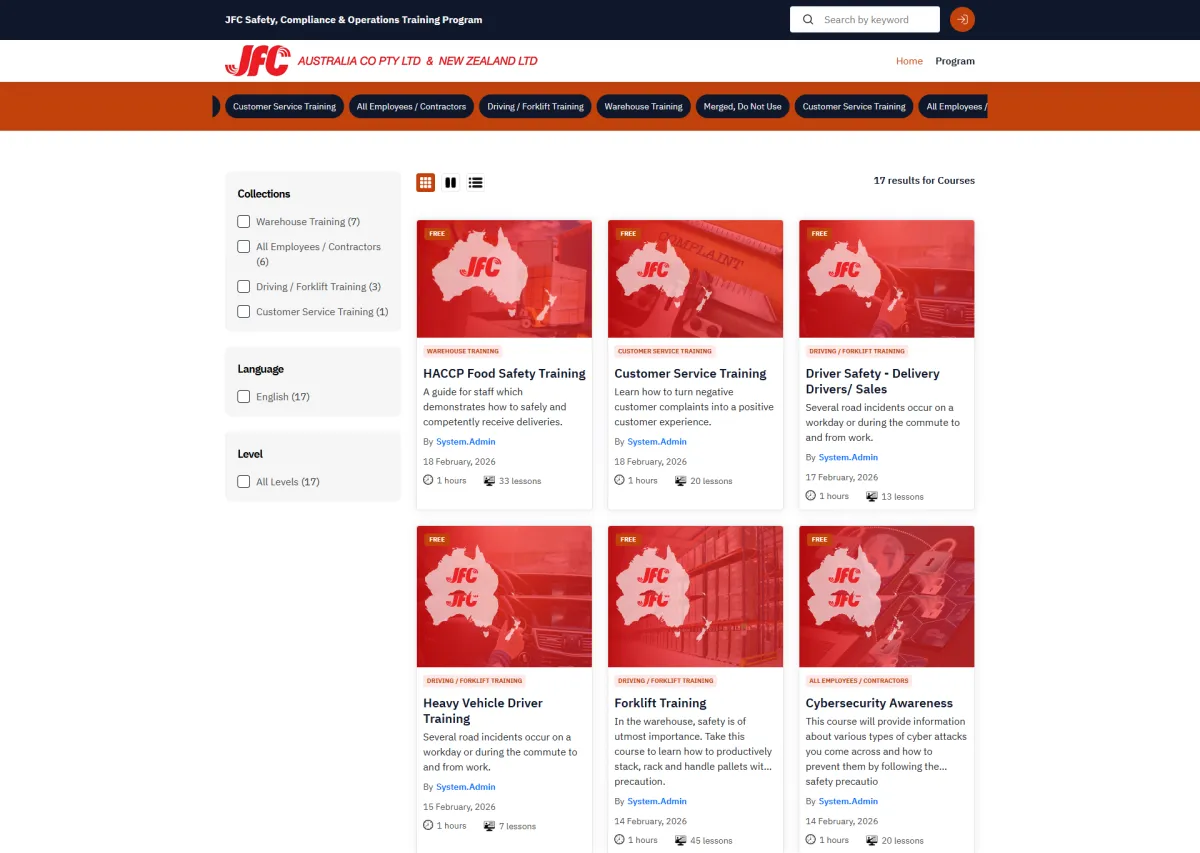
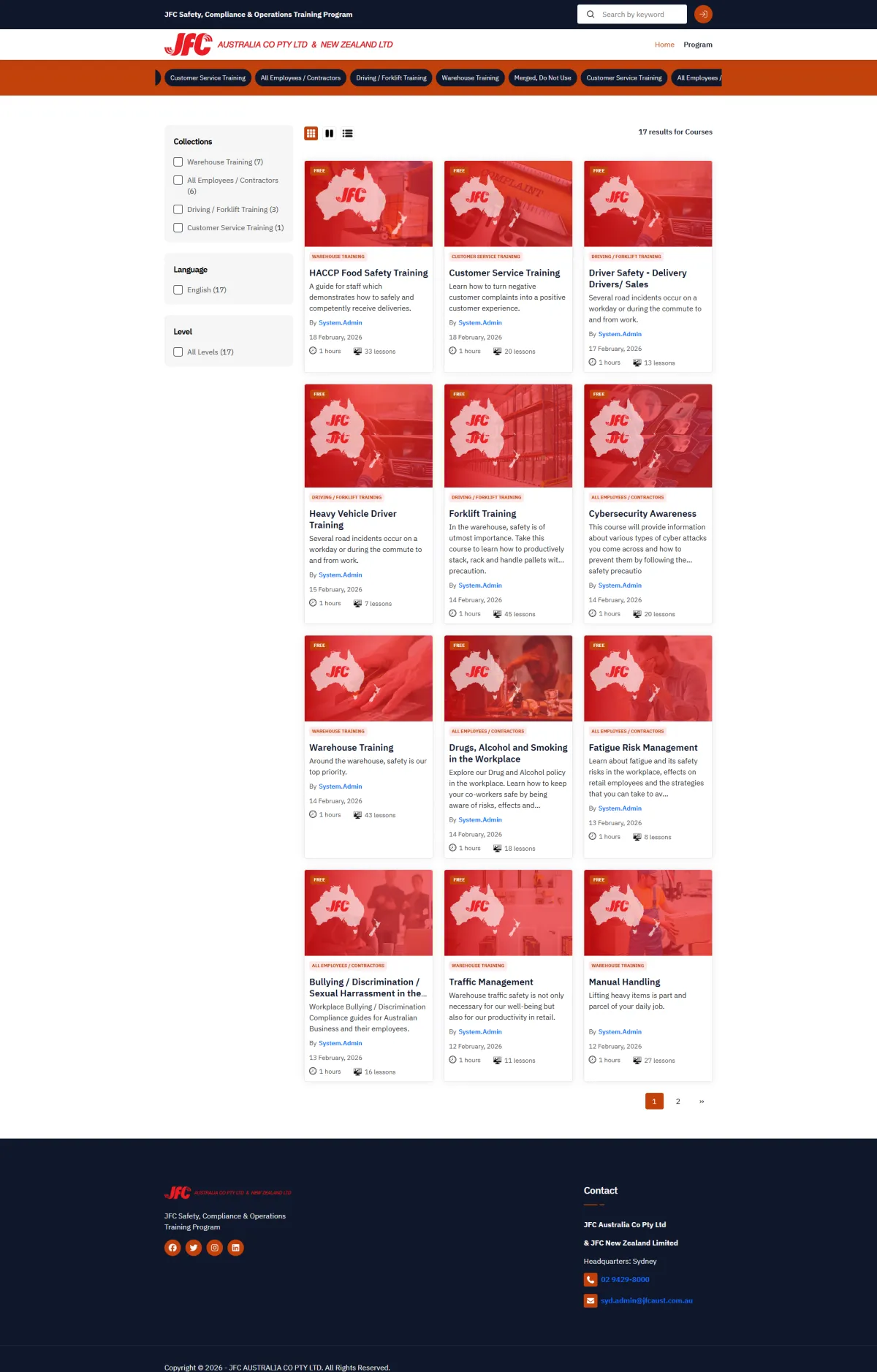
The course catalogue shows the kind of operation the training serves. Courses are grouped into collections for all employees and contractors, for warehouse staff, for drivers and forklift operators, and for customer service staff. They cover HACCP food safety and receiving deliveries; forklift operation, pallet racking and stacking; cold storage, warehouse traffic management and manual handling; driver safety for delivery and sales staff and for heavy vehicle drivers; fatigue risk; fire and emergency evacuation; induction; cybersecurity awareness; drugs and alcohol in the workplace; and bullying, discrimination and harassment. The people taking these courses work in warehouses, in vehicles and with customers, and some of them are contractors rather than employees.
The problem
The portal makes the training needs plain. Some courses apply to everyone who works for JFC, contractors included: induction, fire and emergency evacuation, cybersecurity awareness and workplace conduct. Others apply to one kind of work only, such as forklift operation or heavy vehicle driving. A learner has to find the courses that apply to their role without reading through the whole catalogue, so the catalogue has to be sorted by who each course is for.
Most of the content is safety and compliance training, where completing a course is the point. Forklift training, for example, runs from pallet, rack and stacking safety through unloading shipping containers, receiving and storing product, cold storage, forklift inspection and operation and handling loads, to safety around unloading trucks, and it ends in a quiz. A course like that needs modules and lessons a learner can work through in order, an assessment at the end, and a certificate once the learner has completed it.
Some courses teach JFC's own procedures rather than general advice. The HACCP food safety course is a guide for staff on receiving deliveries safely, and its lessons follow the receiving checks in turn: transport condition, product condition and temperature, with the critical limits and the corrective action to take, then documentation and records. It goes on to temperature checks in cold storage and at dispatch and delivery, allergen awareness, cleaning, housekeeping and pest control. The fire course sets out the fire response and evacuation procedures, the duties of key personnel, the procedures for the evacuation coordinator and the area wardens, and evacuation practice. Material like this belongs to JFC, and the portal has to publish it under JFC's name.
The portal also has to work for the people who run the training, not only for learners. It is meant for online training, learner management and professional development, so administrators and trainers need to create, deliver, track and manage courses in one place, and learners need to reach them on whatever device they have.
What we built
JFC's portal is a deployment of EverLMS, WeebPal's Drupal learning platform, customised for JFC. EverLMS already covers the core of a learning system: course discovery, enrolment, lesson progress, quizzes, certificates and role-based back-office management. The work for JFC was to fit that platform to JFC's courses, collections and learners.
What a visitor sees on the portal today:
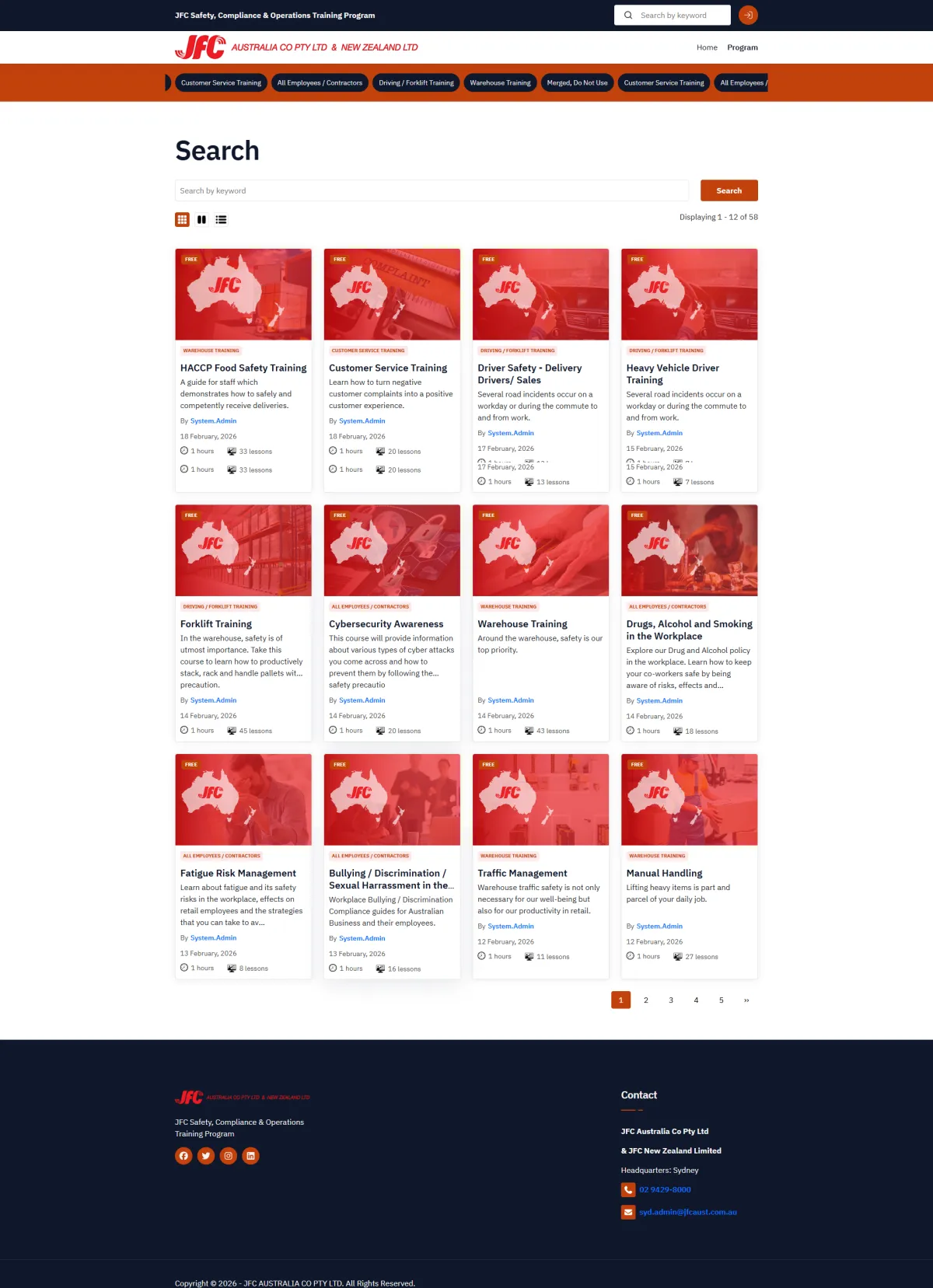
- A course catalogue under JFC's own name and domain, filtered by collection, language and level, in a grid or list view. Each course card shows its collection, its length and its number of lessons.
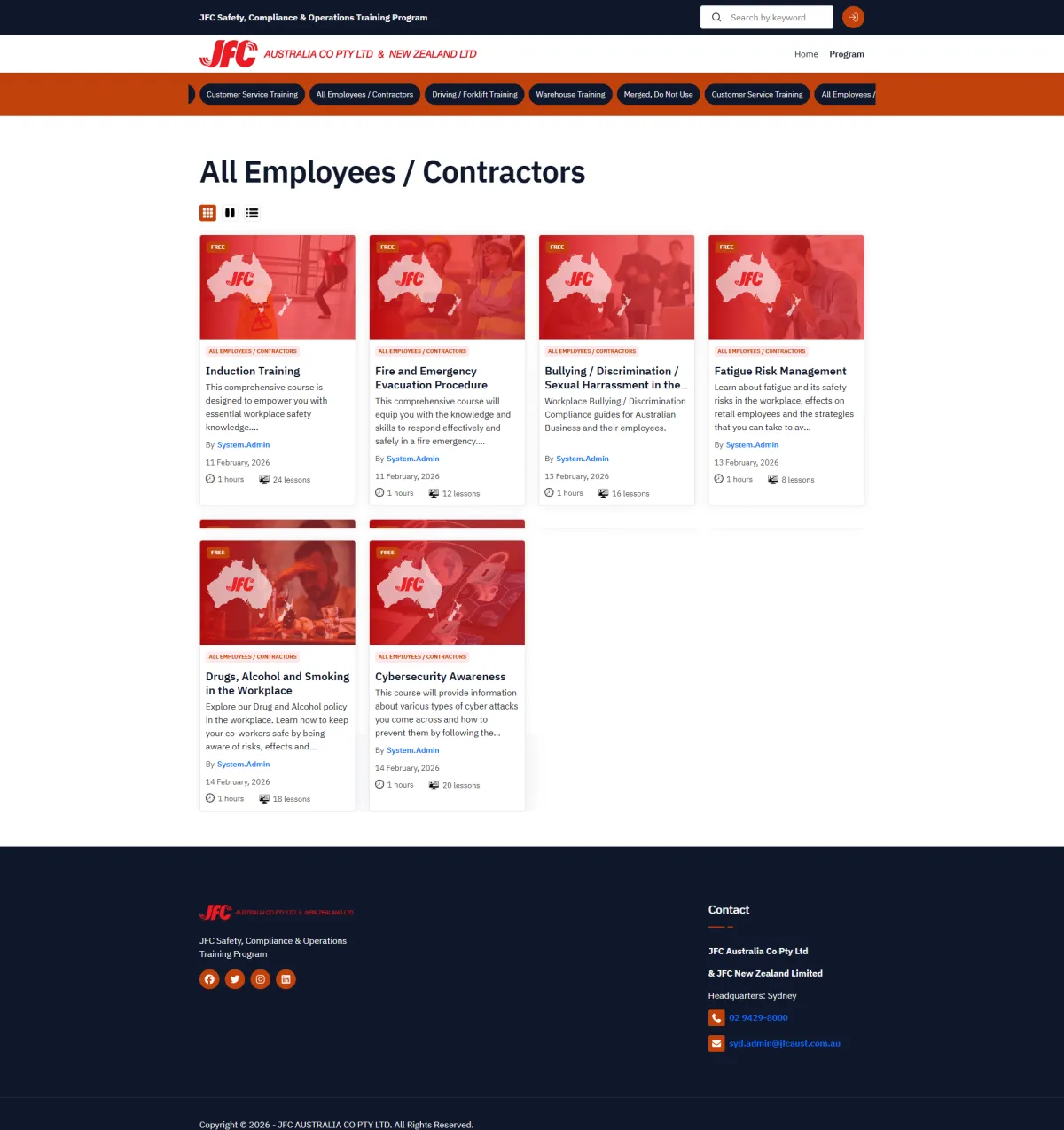
- A programme page that lists every course under its collection, so a learner can see which courses belong to their kind of work.
- A page for each collection, linked from the main menu, that lists only the courses in that collection.
- A course page with the collection, the lecturer, the number of learners enrolled, the date of the last update and the languages available, and separate tabs for course information, lessons and the quiz.
- A lesson outline grouped into modules, so a long course reads as a sequence of topics rather than a flat list of lessons.
- A summary of what each course includes: its length, its quizzes and lessons, a certificate of completion and lifetime access.
- Popular and similar courses on each course page, leading a learner on to the next course in the same area.
- No public sign-up: registration is closed, and learners log in with a username or email address. A forgotten password is reset through instructions sent to the learner's registered email address.
- A detail page for each quiz, open before login, that gives the number of questions, the difficulty, the time limit and the pass mark.
- Quizzes that open only after login, so each attempt belongs to a learner account.
The portal also reports on the training. A user's profile carries a user report for managers, which gives that user's course count, passed and failed counts, the number of quizzes not yet taken, a completion rate and an average quiz score.
The EverLMS page records this deployment as an LMS with structured learning pathways, assessments, certificates and progress tracking on any device, and the scope recorded for the project adds user management and reporting and analytics. EverLMS keeps customisation apart from the platform core, so a core upgrade does not overwrite it.
Our role
WeebPal deployed EverLMS for JFC, customised it for JFC's training programme, carried out the AI integration that is part of the project's scope, and maintains the portal now that it is live. The AI integration does not show on the portal's public pages, so this case study does not describe it; it is the kind of work described under AI solutions. EverLMS is our own platform: we build it, and a deployment starts from the version already running in production rather than from an empty repository.
Maintaining the running portal is the kind of work described on our support and maintenance page. How we approach learning platforms for training organisations is set out on the education and training page.
The result
The portal went live in 2026 and is running at lms.jfcsystem.com.au, where WeebPal maintains it. JFC publishes its safety, compliance and operations courses there under its own name, and its course pages show the learners enrolled and the date each course was last updated.
Screens
If you are planning something similar
Each service page sets out how we run that work, what you receive and how it is priced.
Platform Implementation and Customisation
One of our ready-made Drupal platforms, already in production, deployed and customised for your organisation, then handed over as a running system with its source code.
AI Development for Drupal and Web Platforms
RAG assistants, document extraction and AI workflow steps built into Drupal and web platforms, with a record of what data leaves your system.
Software Product Development
MVPs and new software products built on a platform we already run in production, with the system and its source code handed to you.
More case studies

See it working before you commit
We build a working prototype first, so you decide against something real.