Industry

Education and Training Websites on Drupal

Learning platforms for training providers and staff training programmes, built on EverLMS with courses, quizzes, certificates and SCORM support.

An engineer reads it and replies within one business day.

  • EverLMS in production at JFC
  • Courses matched to each staff role
  • Source code handed over

Who we build this for

  • Corporate L&D
  • Training providers
  • Staff training programmes
  • EdTech startups

Case studies

What has this actually been used for?

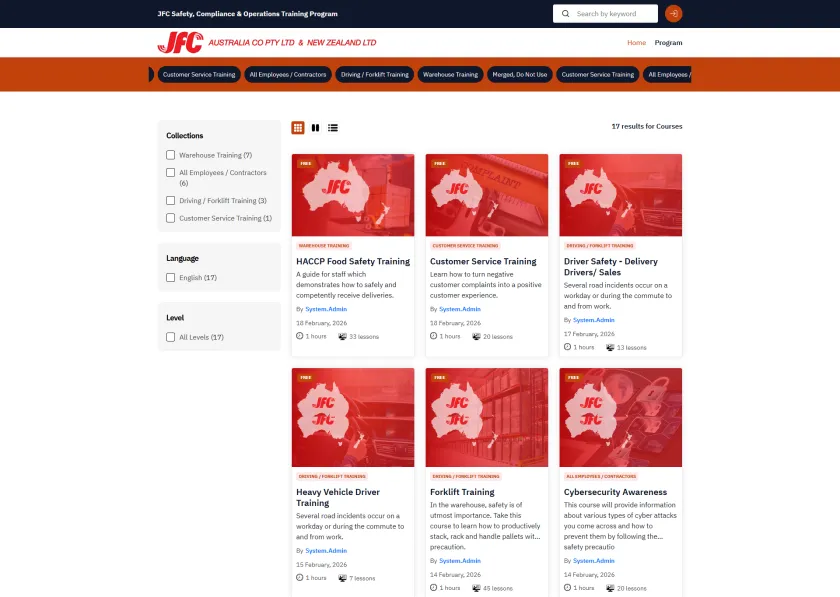
JFC runs its staff training on EverLMS at lms.jfcsystem.com.au, under the name JFC Safety, Compliance & Operations Training Program. The courses serve people who work in warehouses, in vehicles and with customers across JFC Australia and JFC New Zealand, contractors included: HACCP food safety and receiving deliveries, forklift operation and cold storage, driver safety, fire and emergency evacuation, induction and workplace conduct.

We deployed EverLMS for JFC, customised it for JFC's training programme and maintain the portal now that it is live. The EverLMS platform page covers the platform itself.
See more of the work

What shapes the work

Why is training software harder than it looks?

A learning platform is judged on its busiest week: a compliance deadline, a new intake of staff, a course everyone has to finish before an audit. The rest of the year hides the problems that week exposes.

  • Content that outlives the tool it was authored in.

    Course material is bought, inherited and migrated. If the platform cannot ingest SCORM packages and H5P interactions as first-class content, years of authoring is stranded the day the platform changes.

  • Assessment that is more than a multiple-choice box.

    Real courses need matching, short answers, essays marked by a person, file uploads, and mixed papers that combine them. Platforms that model only one question type push the rest into attachments, and the results stop meaning anything.

  • Certification that has to stand up later.

    A certificate is a record someone will present to an employer, an auditor or a regulator. It has to be issued automatically, dated, traceable to the attempt that earned it, and re-issuable years later.

  • Courses that apply to some people and not others.

    Induction and workplace conduct apply to everyone, contractors included; forklift operation applies to the people who drive one. A learner has to find the courses meant for their role without reading the whole catalogue.

  • Roles that do not fit "student and teacher".

    Staff training has line managers who need to see their own team and nobody else's, trainers who publish courses, and administrators who answer for completion. Permissions are the requirement, not a setting.

Underneath all of them sits the question organisations ask last and regret asking last: who holds the code, and what happens at renewal. A platform rented per seat gets more expensive exactly as the programme succeeds.

How we build it

How do we build a learning platform that survives its own success?

We start from EverLMS, our own learning platform, rather than from an empty Drupal install. It already carries the parts every training programme needs and nobody enjoys rebuilding: course discovery and enrolment, lesson progress, an assessment engine with single and multiple choice, true/false, short answer and essay, file upload and matching questions, automated certificates, memberships, Zoom sessions, and SCORM and H5P support. The work then goes into what is specific to you, as a platform implementation handed over with its source code.

  • Courses sorted by who they are for

    Collections by role or kind of work, so each learner reaches the courses that apply to them. JFC's portal groups its courses for all staff and contractors, for warehouse staff, for drivers and forklift operators, and for customer service staff.

  • Accounts you control

    Registration closed where learners are given their accounts, sign-on against the identity provider you already run, and the roster taken from the HR system that already holds it rather than typed in twice.

  • Assessments and certificates

    Quizzes with a pass mark and a time limit, taken inside a learner account so each attempt belongs to someone, and a certificate of completion issued from the attempt that earned it.

  • Reporting for whoever answers for it

    Reports built for the person who has to answer for completion: on JFC's portal a manager's user report gives course counts, passed and failed counts, quizzes not yet taken, a completion rate and an average quiz score.

Which of our services does this work use?

  • Platform implementation: EverLMS deployed and customised for your organisation, then handed over as a running system with its source code.
  • Custom web application development: a training system engineered to a written specification, where a ready-made platform is the wrong starting point.
  • AI development: AI steps built into the platform you run, as in the JFC project.

How is this bought?

Deploying EverLMS with your branding, your workflows and your integrations sits between the Small and Large sizes on our pricing page, depending on how far past the defaults you go. A platform engineered to a written specification is custom development. Either way the architecture is agreed and the price fixed before delivery starts, and a working demo runs on your own data before you commit.

In both cases you receive the full source code, so a later procurement cycle is a choice rather than a migration (why we contract that way). Development work carries a warranty of one year by default and up to three, worked by the team that wrote it (what the warranty covers), and support and maintenance is available as a separate ongoing arrangement.

What do we need from you before we can quote?

Not a written specification: producing one is usually part of the work. What we do need early is the shape of the programme: how many learners, how many at the busiest moment, which identity provider and which HR or student record system, what your assessment rules actually say, and whether existing course material has to come across.

From there the engagement starts with a requirements session and a mindmap rather than a document, then a working prototype built against your own content. You correct something you can click, and only once the prototype matches what you meant do we design the architecture and fix the price. That is deliberate: in training the expensive mistakes are made in the assessment and completion rules, and those are the parts a document hides and a prototype exposes. Questions that come up before that call are answered on our FAQ page.

See the platform running with your case on it

Tell us your use case and roughly how many users. We set your case up on the version in production and go through it with you one role at a time, before anything is signed.

  • Full source code, handed over
  • Price fixed once the architecture is agreed
  • Warranty of 1 to 3 years