
An AI-assisted delivery workflow, refined across more than 10 internal projects and applied to five released projects.
The problem is no longer writing code faster
A large software project rarely fails only because the team writes code too slowly. It fails because requirements are ambiguous, architecture drifts across modules, decisions are not traceable, feedback has no owner, or defects travel through too many stages before anyone catches them.
AI changes the speed of execution. It does not remove those problems, and in some cases it makes them worse: a wrong assumption now propagates through documentation, code and tests faster than a person can notice it.
So the question we are pursuing at WeebPal is not, “How many lines of code can AI generate?” The harder question is:
How should a small team organize AI to deliver a large software project while keeping architecture, quality, and accountability under control?
Since May 2026 we have been applying and refining this workflow on real work: more than 10 internal projects, of which five have reached release with planned scopes of roughly 500 to 5,000 engineering hours. Those hours describe the scope and complexity of the work, not elapsed delivery time and not a productivity multiplier. “Large” here means large for a small delivery team.
The first thing that became clear is that capacity is not method. More AI throughput produces more output; it does not produce requirements, architecture, quality gates, ownership or accountability. Those have to be designed into the delivery system deliberately.
This is not a finished formula. It is an operating method being tested and corrected through each delivery, and the sections below describe where it currently stands.
When AI becomes the execution layer
AI cannot solve a large system with one enormous prompt. It needs to operate inside a model with explicit inputs, artifacts, standards, and quality gates.
In our model, the division of responsibility is straightforward:
- Humans define the problem, scope, standards, and boundaries.
- AI produces much of the documentation, code, and test output, and supports iterative revision.
- Automated gates verify what can be measured.
- Independent reviewers assess business logic, architecture, functionality, and user experience.
- Humans decide on exceptions, accept risk, and remain accountable for the final outcome.
AI builds. Humans decide and remain accountable.
AI is the execution layer inside the process. It is not a decision-making role, and it is not the owner of the delivery outcome.
This does not make human capability less important. The opposite is true. As AI takes on more execution work, the quality of human requirements, architecture, standards, and judgment becomes more visible than ever, because there is less manual labour left to hide behind.
Quality does not come from trust
AI can misunderstand a requirement, fill in missing information, or produce convincing code that contains a defect. Humans can also misunderstand, overlook details, and make decisions that later need to change.
The right question is not, “Will AI make mistakes?” The right question is whether the process can detect, trace, and resolve those mistakes before the result passes an acceptance gate.
Artifact quality loop: Requirement → Execution → Verification → Issue found → Fix → Retest
Every pass should leave evidence: which requirement was checked, which issue was found, what changed, and which gate passed. If a defect is fixed only in code but never becomes a test, a checklist, or a piece of shared knowledge, a similar defect will return.
AI does not need to be perfect to create value. The system around it must make errors easy to detect, inexpensive to fix, explicitly owned, and unable to move forward silently.
Six stages of a large software project
Before defining the 18-step operating flow, we divide the project into six types of work. Each stage has its own inputs, outputs, and acceptance conditions:
- Requirements analysis: clarify business goals, users, workflows, data, constraints, and acceptance criteria.
- Architecture design: define system context, modules, entities, APIs, permissions, deployment, and decisions that are difficult to reverse.
- Work breakdown structure (WBS): trace every requirement to epics, stories, tasks, dependencies, tests, and a Definition of Done.
- Development: implement small, testable slices within shared architecture and conventions.
- Automated testing: run linting, static analysis, unit, integration, end-to-end, contract, security, and appropriate threshold checks.
- Human review and acceptance: let people evaluate business value, user experience, exceptions, and release readiness.
These six stages form the map. To operate the project, that map needs a route: who creates the result, who reviews it, where feedback returns, and when the work is allowed to move forward.
The 18-step workflow and three role groups
Three groups are accountable across the flow: Project Manager and Solution Architect (PM/SA), Tech Lead, and the delivery review group of Developers, Business Analysts and Quality Control (Dev/BA/QC). AI operates inside the steps, not as a fourth column: it never holds accountability of its own.
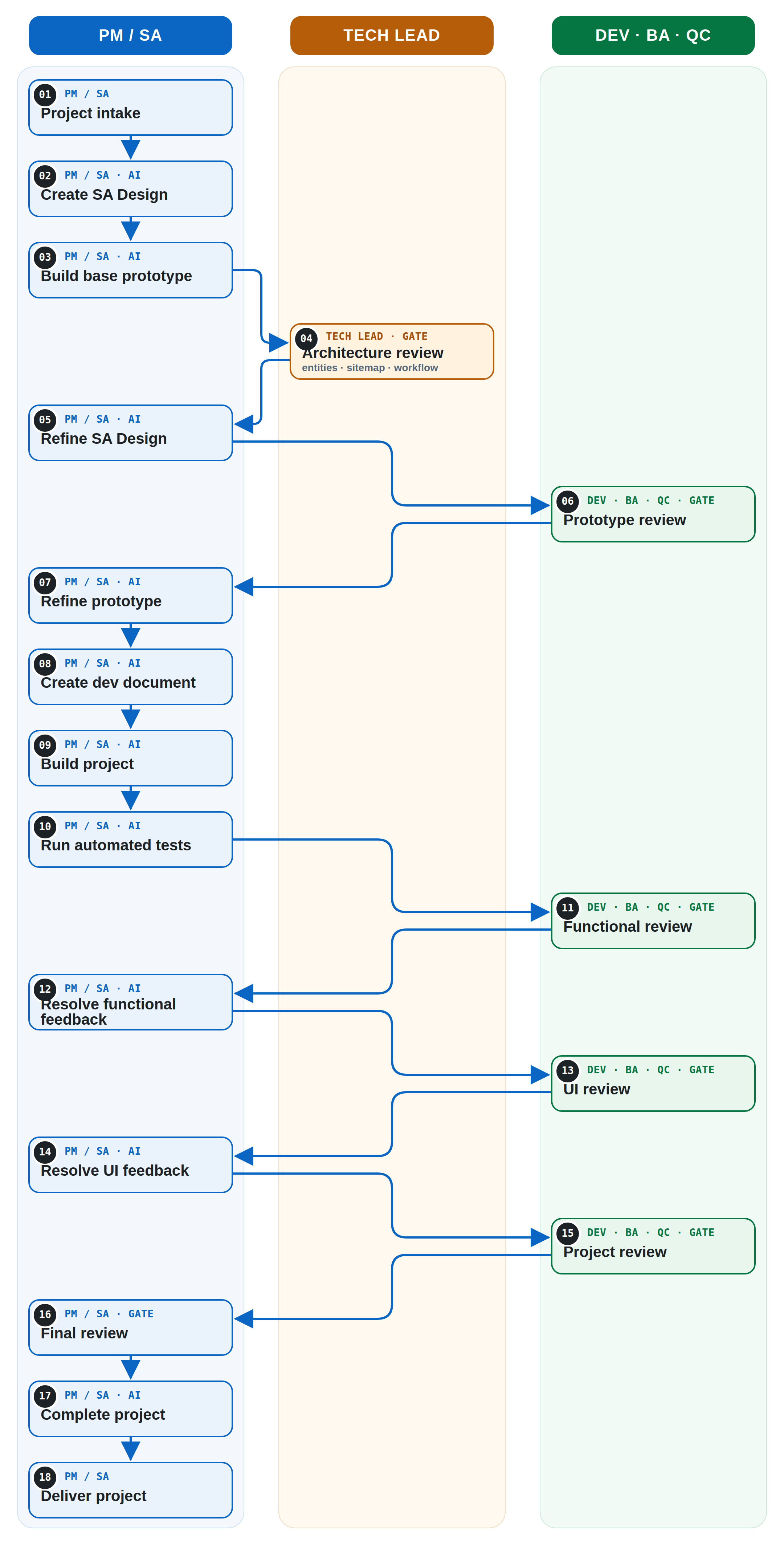
The eighteen steps fall into five rhythms. Reading them as rhythms rather than as a list is what makes the flow reconstructable:
Design initiation. PM/SA takes in the project, works with AI to produce the SA Design, and builds a base prototype. The prototype exists this early on purpose: it is cheaper to correct a misunderstanding on a screen than in a finished module.
Design convergence. The Tech Lead reviews the architecture (entities, sitemap, workflows, and the decisions that are expensive to reverse) while Dev/BA/QC review the prototype. PM/SA folds both sets of feedback back into the design and the prototype. Nothing proceeds to build until this convergence closes, because every later step inherits whatever is wrong here.
Building. PM/SA and AI turn the agreed design into development documentation, then into implementation, then run the automated test suite. The documentation step is not ceremony: it is the artifact that keeps multiple AI agents producing consistent work against one architecture.
Review and resolution. Dev/BA/QC review functionality, then the interface, then the project as a whole. Each review has a matching resolution step owned by PM/SA. This pairing is the part most often skipped elsewhere, and it is the reason feedback in this flow cannot quietly expire.
Completion and delivery. PM/SA performs the final review, completes the project, and delivers it.
Two rules hold the flow together. Every feedback item returns to a resolution step: a review comment is not optional advice; it has an owner, a fix, and a retest. And if architecture drift appears during the build, the flow returns to the architecture gate rather than routing around it. A quality gate is never lowered merely to close a delivery cycle.
This is a delivery cycle, not a one-way pipeline
Each delivery cycle runs the same path from intake to delivery, but its scope and depth are set by that cycle's objective.
The first cycle prioritizes an end-to-end version of the critical flows so that architecture, business logic, and experience can be validated early. “Complete” means the selected scope has passed its gates. It does not mean every edge case has reached its final depth.
Later cycles inherit the approved artifacts, code, tests, and decisions, then deepen security, performance, UX, and test coverage while incorporating real-world feedback.
The artifact quality loop above governs a single artifact; a delivery cycle spans the whole project. Within each stage of a cycle, the rhythm is the same four beats:
- Humans provide the requirement and the acceptance criteria.
- AI executes and produces a result.
- AI and automated gates review, challenge, test, and revise that result.
- Humans review it against the objective and accept the decisions that matter.
After each pass, approved decisions become context and standards for the next one. The project does not simply improve; it learns from every correction.
What must be true for this model to work
An AI subscription does not create delivery capability by itself.
The process needs
- Requirements clear enough that AI does not invent the core business logic.
- Architecture, conventions, and a technical foundation standardized enough for multiple agents to produce consistent results.
- Work divided into small units that can be reviewed and accepted.
- Measurable acceptance criteria, a Definition of Done, and pass/fail conditions.
- A test suite and quality gates strong enough to stop recurring defects.
- An owner and a corresponding feedback-resolution step for every gate.
- Independent review, rather than asking one agent to validate its own interpretation in the same context that produced it.
Where the process breaks down
- Requirements remain ambiguous while AI is expected to fill in the gaps.
- Multiple agents generate code in parallel without shared architecture and conventions.
- Tests confirm the implementation but are never checked against the acceptance criteria.
- Feedback has no owner, or an issue is closed without a retest.
Without these conditions, AI does not reduce chaos. It reproduces incorrect requirements, weak architecture, and technical debt at greater speed.
What we measure
A process becomes a method only when it can be observed, repeated, and improved. These are the questions we track on every cycle:
- How many requirements and critical flows are covered?
- How many defects of each severity does each gate catch?
- How many defects escape automated checks and reach human review or a live environment?
- How many review → resolve → retest cycles does each gate require?
- Which artifacts, checklists, tests, or conventions were added after each defect?
- How many resources did AI consume, and what did that cost?
We are not publishing numbers against these questions yet. Five releases is a small sample, the instrumentation changed between them, and figures produced under those conditions would suggest more precision than we have. What we can say is which questions decide whether this is a method or a diagram, and these are they.
What five releases have and have not shown
Five released projects do not prove that the process is perfect or complete. What they provide is operational evidence: which gates remain weak, which artifacts are still unclear, and where human–AI coordination has to be redesigned.
We are not trying to prove that AI never makes mistakes. We are testing whether a process can detect errors, correct them, and learn fast enough to deliver real projects.
Further reading
This article is the next step in a line of thinking developed across three earlier pieces:
- 6 Levels of AI-Coding: From Individual Speed to Organizational Delivery: Places AI coding on a maturity path from individual assistance to organization-level delivery capability.
- AI Has Already Rewritten the Software Development Process: Explains why requirements, reviews, and feedback loops must be redesigned once coding is no longer the primary bottleneck.
- How the WeebPal Development Framework works: Defines an operating model in which humans command and AI amplifies execution capacity.
If those articles addressed maturity, process redesign, and role allocation, this one is where the ideas become a concrete delivery workflow.
Where this stands
After five releases, our working conclusion is that AI delivery is less a model-selection problem than a systems-design problem.
The more execution AI absorbs, the more explicit a project has to become. Requirements must be traceable. Architecture decisions must persist somewhere other than inside a prompt. Acceptance criteria must be measurable. Feedback must have an owner. A resolved defect must strengthen the tests, checklists, or standards that govern the next cycle.
The open questions are quantitative, and they are the ones listed above: which gates prevent the most expensive defects, where issues still escape, how much human review is needed as parallelism increases, and how the economics change on larger projects. Answering them is the next phase of this work.
If you lead an engineering or product team running AI-assisted projects and you are measuring similar questions, we would be glad to compare notes. Get in touch →
The goal is not error-free AI. It is a delivery system that makes errors visible, recoverable, and progressively less likely to recur.