
When writing code is no longer the hardest part, what actually matters?
Table of Contents
- Introduction: Writing Code Is No Longer the Hardest Part
- The Traditional Process: Looking Back to See the Problem
- How AI Changes Each Step
- New Roles for Humans
- Knowledge Base: The Organization's Long-Term Memory
- Agile: From Unfulfilled Promise to Reality
- Risks & Warnings
- Efficiency Multiplies, but the Market Expands Far More
- Software Zombies
- Conclusion: This Is Not Theory, It's a Process Already in Action
1. Introduction: Writing Code Is No Longer the Hardest Part
Think back 20 years. If you wanted to build a hotel management system, what did you need? A team of 5–10 developers, months of coding, countless meetings to understand the business, then more months to fix bugs. Most of the time, money, and energy went into one thing: writing code.
That era is rapidly fading.
With the rise of AI Agents, writing code, once the biggest bottleneck, is becoming the fastest step. AI can produce large volumes of working code in very little time, something that would take a skilled developer days or weeks.
If code is no longer the hardest part, what actually matters?
This article walks through the entire software development process, from idea to production, and analyzes how AI is reshaping each step. Not to hype the technology, but so that you, whether you're a developer, PM, or founder, understand where you stand and what to prepare for.
2. The Traditional Process: Looking Back to See the Problem
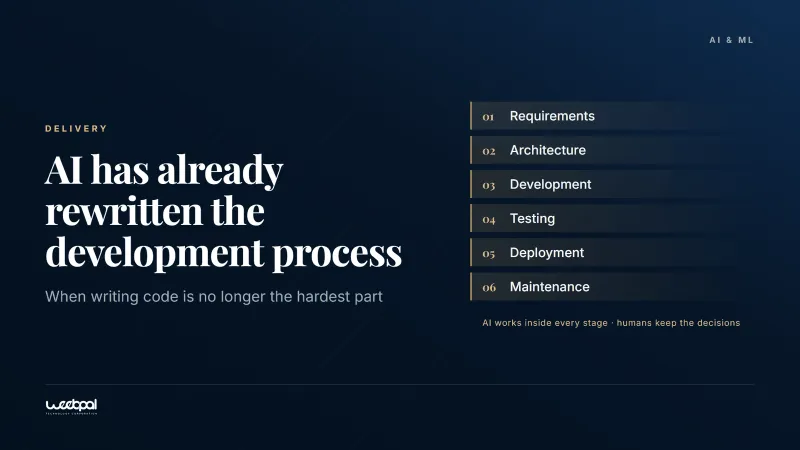
Whether you call it Waterfall, Agile, or anything else, the essence of software development always revolves around 6 phases:
Requirements → Design → Development → Testing → Deployment → Maintenance
- Communication gap: The client says one thing, the developer understands another.
- Scope creep: "Just add a small feature", a phrase that has killed countless timelines.
- Bad estimates: "Two weeks" turns into two months.
- Buggy code: Missed edge cases, production bugs at midnight.
- Missed deadlines: The inevitable consequence of all the above.
The cost of fixing bugs increases with each phase. A requirement error caught early costs 1 hour to fix. Caught in production? Possibly 100 times that.
This is a structural problem, one that exists because of human limitations. AI doesn't eliminate these problems entirely. But it changes the equation at every step.
3. How AI Changes Each Step
3.1. Requirements: From "spec on paper" to "touchable prototype"
Before, both sides imagined the product, but imagined differently. With AI, AI Agents create working prototypes rapidly. Instead of "That's not what I meant" after 3 months, it's "Oh, this part should be different" after a few hours.
Core shift: Requirements become a dialogue around a real product, from day one.
3.2. Architecture: From "reinventing" to "smart reuse"
AI Agents reference a Knowledge Base, where architectural patterns and lessons from previous projects accumulate. When AI handles known patterns, humans focus on what truly needs creativity: decisions specific to the particular problem.
Core shift: "Reinventing every project" → "smart reuse + selective customization."
3.3. Development: From "code writer" to "system designer & reviewer"
Developers become system designers and output reviewers. This may sound diminished, but the reality is the opposite: you can't review what you don't understand. The new role demands broader vision and deeper knowledge, not less.
Core shift: Code is AI's output, but code quality remains the human's responsibility.
3.4. Testing, Deployment & Maintenance
Three phases, one direction:
- Testing → integrated into the development flow, no longer "a separate phase that gets cut."
- Operations → from reactive firefighting to predictive prevention. Detecting anomalies before they become incidents.
- Maintenance → "living software." AI helps analyze very large codebases, enabling continuous refactoring.
Common thread: AI doesn't replace human decisions, but provides context fast enough for humans to make better ones.
4. New Roles for Humans
Not losing jobs, but different jobs. Developers who don't adapt will be replaced by developers who use AI effectively.
- Developer → System Architect + AI Operator: designing systems, making decisions, operating AI Agents, more like a director than an actor.
- QA → Quality Strategist: defining quality strategy instead of manual testing.
- PM → Communication Bridge: connecting business and technology becomes more critical than ever.
- Domain Experts Rise: AI is only powerful when given the right context. Without it, AI can produce impressive-looking output that is fundamentally wrong.
5. Knowledge Base: The Organization's Long-Term Memory
The most valuable knowledge lives in people's heads, but people leave.
With AI, the Knowledge Base becomes the organization's long-term memory. Every pattern, architectural decision, lesson learned, all recorded in a structured, machine-retrievable format. AI Agents can reference and apply them immediately.
When starting a new LMS project, the AI Agent doesn't start from zero. It references the Knowledge Base: "we've built an LMS before, the quiz engine architecture is X, the data model is Y, the pitfalls to avoid are Z." The developer reviews, adjusts, and proceeds.
Like the Toyota Production System: turning individual knowledge into organizational assets, helping AI Agents produce consistent output.
6. Agile: From Unfulfilled Promise to Reality
6.1. Reality: Agile Rarely Reaches Its Ideal
A 2-week sprint sounds short, but in practice? Planning, code, test, scramble to ship, "we'll improve next sprint." Prototype? "No time."
Agile in theory is a complete feedback loop. In practice, it's usually mini-Waterfall, broken into smaller pieces but still missing critical steps.
6.2. AI Makes Agile's Ideal Achievable
Every feature can now run through the complete ideal process:
Discuss → Prototype → Validate → Develop → Test → Review → Improve → Finalize
Before, each step required dedicated human time, and sprints couldn't fit all 8 steps for every feature. AI changes this by handling the heavy lifting at each stage:
Discuss AI analyzes requirements and proposes approaches. A detailed analysis in 15 minutes instead of a 2-hour meeting.
Prototype AI creates a working prototype. Stakeholders see it and validate immediately.
Validate With a real prototype, misunderstandings are caught instantly, not after weeks of development.
Develop AI Agents write code following the validated architecture and patterns from the Knowledge Base.
Test AI generates test cases and runs them. Testing is no longer the step that gets cut.
Review AI assists with consistency and quality checks. Human reviewers focus on business logic.
Improve Because prior steps take less time, there's finally room to refine.
Finalize Truly "done", not "done but drowning in technical debt."
6.3. What This Actually Means for Feedback Loops
Before: 1 loop = 2 weeks. With AI: 1 loop = hours. Problems surface the same day they're introduced.
This is what Agile always aimed for: fast feedback, fast adaptation, continuous delivery. AI doesn't replace Agile; it removes the bandwidth constraint that kept Agile from reaching its potential.
7. Risks & Warnings
- Over-reliance: code works but lacks understanding → hidden technical debt.
- Garbage in = garbage out: wrong KB → AI propagates errors consistently.
- Eroding foundational skills: new developers don't learn fundamentals → can't review AI.
- Security blind spots: AI optimizes for functionality, not automatically for security.
Identifying risks isn't about fear, it's about managing them. A powerful tool in the wrong hands is more dangerous than useful.
8. Efficiency Multiplies, but the Market Expands Far More
8.1. Productivity Increases, but That's Only Part of the Story
Increasing productivity in a fixed market = fewer people needed. That's the perspective that creates fear. But the real story is about market expansion.
8.2. Millions of Problems That Were "Not Worth Solving" Become Real Markets
Before AI, millions of software problems went unsolved, not because they weren't needed, but because building custom software cost more than the problem was worth:
- Badminton court management: booking, dynamic pricing, member management. Who'd invest $20,000 for a single court complex?
- LMS for a 200-student training center: previously? Google Classroom or spreadsheets.
- Boutique hotel with 20 rooms: available PMS too expensive. Result? Notebooks.
Old: "Good software = expensive → only large enterprises can afford"
New: "AI reduces costs → good software accessible to every scale"
8.3. Opportunity Only Comes to Those with the Right Mindset
AI is not staff to delegate responsibility to. AI is an amplifier, it magnifies the capabilities of the person using it.
AI is like a car. If you know how to drive, you can go anywhere. If you don't, you stay put, or worse, you cause an accident.
9. Software Zombies
Not dead yet, but the decline is hard to reverse.
Who Are the Zombies?
Developers, teams, software companies that haven't adapted but are still operating. On the surface still "alive," but speed is slowing, costs are rising.
Why Don't They Die Immediately?
Existing contracts, switching costs, habits, the market needs time to notice. All creating an illusion of safety.
The Decline Is One-Directional
You lose future clients first, then existing ones, then your best people leave.
The process is gradual but hard to reverse, like a handcraft workshop when automated production lines appear.
Signs You Might Be on This Path
"AI writes inaccurate code, I write faster by hand" → The output depends heavily on the input. If results are poor, the approach likely needs adjustment, not abandonment.
"My team is doing fine, no need to change" → "Fine" today doesn't guarantee "fine" next year when competitors have fundamentally different cost structures.
"My clients don't need AI" → But your competitors' clients might choose them for being faster and more cost-effective.
"I'll learn AI when I need to" → The knowledge gap doesn't grow linearly, it accelerates. Every month of delay widens the gap significantly.
10. Conclusion: This Is Not Theory, It's a Process Already in Action
The software development process is being rewritten. Not by a new methodology, but by AI changing the cost structure and feedback speed at every step.
Requirements → working prototypes from day one. Architecture → smart reuse. Development → no longer the bottleneck. Testing → no longer sacrificed. Agile → finally within reach of its original promise.
Those who master the process + Knowledge Base + AI Agent → produce software consistently and scalably. And the market? It's expanding into territory that was previously uneconomical to serve.
"What do I need to do differently to seize this opportunity?"
What I've written here doesn't come from imagination. With 25 years of writing code and the past few months directly applying AI-Powered Development, I've taken complex software products (systems that would traditionally require large teams and months of work) from concept to working product. Not by cutting corners, but by running a tighter process: working prototypes on day one to eliminate requirement ambiguity, AI-generated architecture grounded in a proven Knowledge Base, and a small team of one PM, one technical reviewer, and AI Agents replacing what would traditionally be a much larger group. That's not an exception: it's a repeatable process.
In upcoming articles, I'll share more details about the products I've built with AI, along with the practical lessons behind them.
At WeebPal, we now apply the AI-Powered Development process across our software projects. If you're exploring how to turn complex ideas into working products faster and more reliably, we'd be glad to talk.