
Shipment Control
Customs and trade compliance control for cargo operations
What the screens actually look like
Taken from the working product. Names and figures shown are sample data.
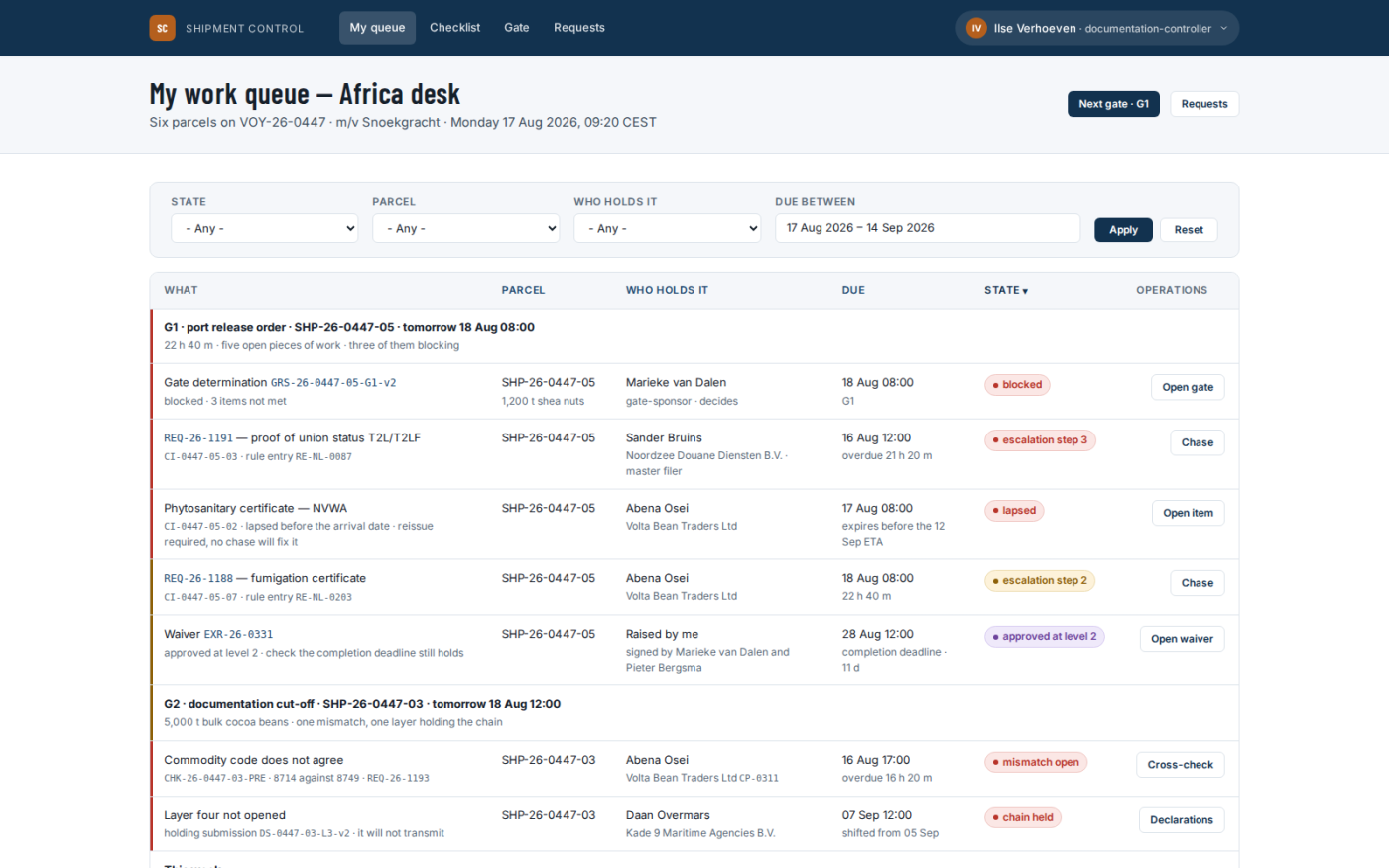
The controller workspace: what is waiting, what is overdue, and who owes it.
About Shipment Control
Shipment Control stops a shipment moving until its compliance file is complete. It builds a document checklist per shipment and per destination country from a versioned rule set, collects the evidence from whoever holds it, and runs a control gate that returns one determination: file complete, blocked, released under waiver, or advisory only.
Built for carriers, forwarders and cargo operators who carry regulatory exposure on what they load.
The rule sets are the asset. Each destination country or customs bloc has its own versioned set with a five-state lifecycle — author and approver must be different people, versions carry a future effective date, and a new version is simulated against twelve months of past shipments before it is allowed to take effect. A rule entry names the certificate, cites its legal basis, states which control point it must be in place before, and declares who bears the obligation, so an importer’s duty never blocks at the carrier’s level while a statutory duty blocks on every shipment.
Determinations are append-only. The gate freezes its whole input vector — rule set version, checklist, elected values, check results, open holds — at the moment it issues, and never edits it afterwards. Evidence is sealed in sets at their own points, and every field records which source it came from, keeping both values when two sources disagree.
Seventeen modules, 128 record types, 24 workflows and 119 capabilities, on Drupal with a single-writer database.
Key Features
Use Cases
See how Shipment Control fits your industry
Carriers & Vessel Operators
Hold cargo at the berth until its documentation file clears, and keep the determination as sealed evidence afterwards.
Freight Forwarders & Agents
See what each shipment is waiting on and who owes it, with a chase history you can point at when responsibility is argued.
Regulated Export Operations
Enforce certificate requirements per destination country from a rule set that is versioned, reviewed and simulated before it goes live.
Trade Compliance Teams
Keep statutory obligations apart from contractual ones, so a waiver can never be granted where the law does not allow one.
Technology Stack
What Makes Shipment Control Different
Rule changes are simulated against twelve months of past shipments before they can take effect
A determination is append-only and freezes its whole input vector — you can reconstruct exactly why it said what it said
Statutory and sanctions items have no waiver route; only contractual items can be waived, on a configurable ladder
Who bears the obligation is declared per rule, so an importer’s duty never blocks at the carrier’s level
Every field keeps its source — when two sources disagree both values are retained and the operator elects which to use